Taste the Rock: How Palau’s Wild Terrain Cooks Up Unforgettable Flavors
You know what? I never thought geology could make my mouth water—until I got to Palau. Beneath its turquoise waves and jungle-covered islands lies a landscape so wild it shapes how people eat. From coral-laced seafood to earth-roasted feasts, the land doesn’t just feed the body here—it flavors every bite. This is more than dining; it’s tasting nature’s blueprint. In a world where so much food feels disconnected from its origins, Palau offers a rare truth: what you eat is shaped by the ground beneath your feet, the tides that rise and fall, and the ancient rock formations that have stood for millennia. Here, cuisine is not crafted in kitchens alone—it is grown, gathered, and cooked in deep conversation with the island’s soul.
The Island That Eats Like It Lives: Palau’s Food-Meets-Geography Story
Palau is not a flat atoll nation where survival depends solely on coconuts and fish brought in by tide and luck. It is a country of elevation, variation, and complexity—geologically and gastronomically. Composed of over 340 islands, many of them rising steeply from the sea as limestone karsts or remnants of ancient volcanoes, Palau offers terrain unlike any other in Micronesia. This topography does more than inspire postcard views; it actively shapes what grows, where it grows, and how it is prepared. The volcanic islands in the west, such as Babeldaob—the largest—boast rich, fertile soils formed from decomposed basalt and organic matter. These areas support inland agriculture, including taro patches, banana groves, and yam gardens that thrive in the moist, shaded valleys. In contrast, the eastern islands are primarily uplifted coral atolls, where porous limestone dictates what can be cultivated and how water is retained.
Because of this geological diversity, Palauan food culture is not limited to reef fish and coconut milk. Instead, it reflects a layered relationship between people and land. Families grow swamp taro in depressions where freshwater naturally pools, taking advantage of the island’s natural hydrology. Breadfruit trees flourish on slopes with good drainage, their large leaves rustling in the trade winds. Even the placement of a village kitchen or earth oven is influenced by the land’s ability to retain heat or resist flooding. What you eat in Palau is not just a matter of tradition or preference—it is a direct response to the island’s physical blueprint. The terrain tells the story of the meal before the first bite is taken.
This deep connection between geology and gastronomy is rarely acknowledged in mainstream travel writing, yet it is central to understanding Palauan life. When a family prepares a feast, they are not simply cooking—they are interpreting the land’s offerings. A dish of grilled reef fish wrapped in banana leaves speaks of the coral reefs below. A mound of steaming taro reflects the volcanic soil in which it was grown. Every ingredient carries the signature of its origin. This is not farm-to-table in the trendy sense; it is land-to-mouth in the most literal and meaningful way. Palau’s cuisine is a living map of its geography, and to taste it is to navigate its terrain with your senses.
Journey to the Rock Islands: Where Land and Sea Collide on the Plate
The Rock Islands Southern Lagoon, a UNESCO World Heritage Site, is often praised for its breathtaking beauty—emerald islets crowned with jungle, connected by narrow channels and surrounded by glassy water. But beyond the scenery, this archipelago is a functional food system, shaped by geology and sustained by tradition. These mushroom-shaped islands, formed by the erosion of limestone over thousands of years, are not solid masses. They are riddled with caves, sinkholes, and underground passages that create sheltered micro-environments where marine life thrives. The maze-like structure of the lagoon provides natural protection from strong currents and storms, allowing delicate ecosystems to flourish in relative safety.
For local harvesters, this means an abundance of seafood that is both diverse and distinct in flavor. Fish such as parrotfish, snapper, and emperor move through the channels, feeding on algae, crustaceans, and small reef organisms whose own diets are influenced by the mineral content of the water. Clams grow in the quiet shallows, their shells incorporating calcium from the surrounding coral rock. Even the water itself has a unique composition—filtered through limestone, enriched by tidal exchange, and warmed by shallow sunlit pools. This combination creates what some elders describe as “sweet water, strong fish”—a subtle but noticeable difference in taste compared to fish caught in open ocean or degraded reefs.
One of the most remarkable examples is the milkfish found near the fringes of Jellyfish Lake and other marine lakes. These landlocked bodies of water, formed when coral atolls closed off from the sea, have developed their own ecological balance. The milkfish that enter these zones during high tides feed on plankton and microorganisms adapted to brackish, mineral-rich conditions. Locals who harvest these fish note a cleaner, more delicate flavor—less oily, more refined. While scientific studies on this specific variation are limited, sensory knowledge passed down through generations confirms that the fish from these unique geological pockets taste different. This is terroir not for wine, but for reef—a concept that is only beginning to be recognized in sustainable food discussions.
Earth Ovens and Lava Gullies: Cooking with the Land’s Heat
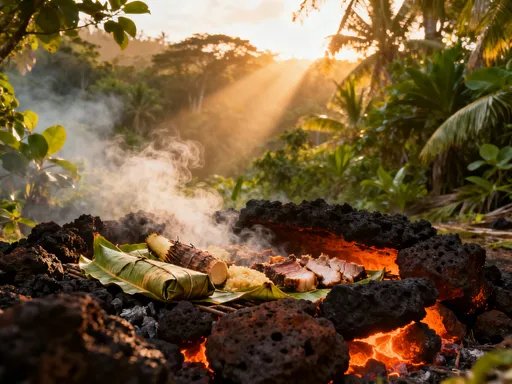
In many Palauan villages, the heart of a feast is not the stove or the grill, but the *kum*—a traditional earth oven that transforms raw ingredients into tender, smoky delicacies. This method is more than a cooking technique; it is a demonstration of how the island’s geology supports daily life. The *kum* is dug into the ground, often in areas with volcanic soil that retains heat exceptionally well. Stones are heated in a fire for hours until they glow, then placed at the bottom of the pit. Layers of banana leaves wrap the food—whole pigs, baskets of taro, loaves of breadfruit—creating a sealed environment that steams and roasts simultaneously.
The volcanic soil plays a crucial role in this process. Unlike sandy atoll soils, which lose heat quickly, the dense, mineral-rich earth of Palau’s volcanic islands holds thermal energy for extended periods. This allows the food to cook slowly, sometimes for 12 hours or more, resulting in meat that falls off the bone and root vegetables that melt in the mouth. The banana leaves, harvested from local groves, add a subtle herbal aroma while protecting the food from direct contact with the stones. The entire process is a collaboration between human knowledge and natural advantage—cooking that could not exist without the island’s specific geological makeup.
During a visit to a village on the island of Peleliu, I watched an elder named Tem take charge of the *kum* preparation for a family celebration. He tested the soil with a stick, probing for moisture and density. “Too sandy, no good,” he said, moving the site a few feet. “Here—the earth remembers the fire.” His words were poetic, but they reflected a deep understanding of the land. The success of the meal depended not just on the quality of the ingredients, but on the ground itself. When the oven was finally opened hours later, the aroma was overwhelming—smoky, sweet, earthy. As the family gathered around, Tem smiled. “This taste,” he said, “you cannot make in a metal box. The land gives it.” And he was right. The flavor was unlike anything from a modern oven—deep, layered, alive with the essence of place.
Coral Soil and Jungle Gardens: The Secret Behind Palauan Produce
Most people imagine Pacific Island agriculture as limited to coconuts, pandanus, and maybe a few root crops grown in sandy soil. But in Palau, the combination of uplifted coral reefs and volcanic deposits creates surprisingly fertile conditions for a wide variety of produce. When ancient coral platforms were pushed above sea level by tectonic activity, they began to break down over centuries, forming a soil that is both porous and rich in calcium. Mixed with organic matter from jungle vegetation, this soil supports a surprising range of crops, including taro, yams, bananas, giant swamp cucumbers, and even pineapples.
In the interior of Babeldaob, families maintain small jungle gardens, often located in natural depressions or sinkholes where rainwater collects and humidity remains high. These micro-environments mimic the conditions of wetlands, allowing swamp taro (*Cyrtosperma merkusii*) to grow year-round. The plants send their roots deep into the moist soil, drawing nutrients from the decomposed coral and leaf litter. Because the land is elevated, these gardens are less vulnerable to saltwater intrusion than those on low-lying atolls, making them more reliable sources of food. The result is a steady supply of starchy, nutrient-rich vegetables that form the backbone of traditional meals.
One such garden, tended by a family in the village of Ngerkeai, is hidden beneath a canopy of breadfruit and mango trees. The owner, a woman named Louch, explained how she uses fallen leaves and composted kitchen scraps to enrich the soil further. “The land gives, but we must give back,” she said, turning over a handful of dark, crumbly earth. Her garden produces enough taro and yams to feed her household and contribute to community feasts. She also grows a rare variety of banana known for its sweetness, which she attributes to the mineral content of the soil. “It grows nowhere else like this,” she said. “The rock makes it special.” Her words underscore a truth often overlooked: Palau’s agricultural strength lies not in its size, but in its geological complexity. What might appear as rugged, untamed terrain is, in fact, a carefully managed and deeply productive landscape.
Harvesting from the Limestone Maze: Clams, Crabs, and Coastal Wisdom
At low tide, the coastline of Palau transforms into a vast, living pantry. The exposed limestone platforms, carved by centuries of wave action, are dotted with pools, crevices, and holes that trap seawater and marine life. This intricate network, known locally as *cheldei*, is where families go to harvest clams, crabs, sea urchins, and other coastal delicacies. The porous nature of the rock means that even as the tide recedes, pockets of water remain, keeping the creatures alive and fresh until collection. This natural refrigeration system has sustained Palauan diets for generations, requiring no technology, only knowledge.
Following a fisher named Dals on a morning harvest, I learned how to navigate the maze. He moved barefoot across the sharp rock, knowing exactly where to step and where to look. “See this hole?” he said, pointing to a narrow opening. “Octopus hides here. That wider pool—mangrove crab.” He reached in with practiced hands, pulling out a large crab still clinging to the rock. Nearby, he uncovered a giant clam buried in a deeper pool, its shell partially open, filtering the sunlit water. “We take only what we need,” he said. “And never the small ones. The rock gives, but it must rest too.” His approach reflects a deep ethic of sustainability, rooted in both tradition and necessity.
The flavor of the seafood harvested from these zones is distinct—clean, briny, with a mineral edge that some say comes from the limestone itself. Chefs in local restaurants often specify that their clams are “from the cheldei,” as if the origin is a mark of quality. The texture is firmer, the taste more complex than farmed or imported varieties. This is not just anecdotal; studies on bio-mineralization in marine organisms suggest that shellfish growing in calcium-rich environments develop denser shells and may have altered flavor profiles due to their diet and water chemistry. Whether or not science confirms every detail, the people of Palau know what their land provides. And they protect it not just for conservation’s sake, but for the sake of their plates.
From Reef to Table: How Underwater Topography Defines Flavor
The ocean around Palau is not a flat, uniform expanse. It is a dynamic, three-dimensional landscape of ridges, trenches, drop-offs, and coral formations that shape the lives of marine species in profound ways. Just as wine grapes develop different characteristics depending on slope and sun exposure, fish in Palau vary in flavor and texture based on their underwater habitat. A red snapper caught along a deep channel, where currents bring nutrient-rich water, will have firmer flesh and a richer taste than one from a shallow, stagnant flat. The constant movement builds stronger muscles, while the varied diet—crustaceans, small fish, reef algae—adds complexity to the flavor.
Local fishermen understand this intuitively. They know which zones produce the best groupers, which slopes are home to the sweetest parrotfish. Some even name fishing spots based on the taste of the catch: “The Butter Wall,” “The Spice Drop,” “The Honey Ridge.” These names are not marketing—they are oral maps of flavor, passed down through generations. When a family prepares a meal, the choice of fish is not random. It is a deliberate selection based on where the fish lived, how it moved, and what it ate. The terrain, once again, is on the plate.
This connection between underwater geography and taste is increasingly recognized in marine science. Research on fish physiology confirms that habitat complexity influences muscle development, fat distribution, and even omega-3 content. In Palau, where fishing is largely done by hand or small boat, this means that the freshest, most flavorful seafood comes directly from the most geologically diverse areas. It also means that when reefs are damaged by bleaching or pollution, the loss is not just ecological—it is culinary. The “buttery” snapper may disappear. The “spicy” grouper may lose its edge. The flavors that define Palauan cuisine are not guaranteed; they depend on the health of the underwater world.
Sustaining the Source: Why Protecting Palau’s Land Means Protecting Its Cuisine
In 2015, Palau made a bold decision: it designated 80% of its exclusive economic zone as a marine sanctuary, banning all commercial fishing in that area. This was not just an environmental policy—it was a food sovereignty strategy. By protecting the reefs, lagoons, and seamounts, the government ensured that local families would continue to have access to fresh, wild-caught seafood. Similar efforts on land—reforestation programs, bans on plastic bags, and sustainable agriculture initiatives—reflect a broader understanding: that the island’s cuisine cannot survive without its natural foundation.
Climate change, however, poses a growing threat. Rising sea levels risk inundating low-lying gardens. Warmer waters increase coral bleaching, disrupting marine habitats. More intense storms erode coastlines and damage infrastructure. If the land changes, so does the food. Already, some elders report that certain fish are harder to find, that taro patches are less productive. These are not isolated observations—they are early warnings. The taste of Palau is at risk.
Yet there is hope. Community-led conservation projects, youth education programs, and eco-tourism initiatives are helping to preserve both the environment and the culture. Visitors are invited to participate in sustainable harvests, learn about earth oven cooking, and taste meals made entirely from local ingredients. These experiences do more than educate—they create value for traditional practices. When tourists seek out “rock island flavor” or “kum-roasted pork,” they support a system that depends on healthy land and sea.
The message is clear: to protect Palau’s food is to protect its geography. Every limestone ridge, every volcanic slope, every coral channel plays a role in shaping what ends up on the plate. This is not just about sustainability—it is about identity. In a world of mass-produced, homogenized flavors, Palau offers something rare: food that tells the story of its origin. To taste it is to understand that cuisine is not separate from nature, but born from it. And to preserve it is not just a duty—it is a privilege.