You Won’t Believe These Venice Secrets—How I Conquered the Iconic Landmarks Like a Local
Venice isn’t just canals and gondolas—it’s a living maze of history, light, and stone that breathes stories. I walked its narrow calli with no map, chasing sunlit facades and silent squares, only to realize the true magic lies in how you see it. The Doge’s Palace, Rialto Bridge, St. Mark’s Basilica—they’re not just postcard spots. With the right approach, they transform from crowded monuments into intimate encounters with centuries of art and power. This is how I made Venice’s landmarks feel personal, peaceful, and unforgettable.
Seeing Beyond the Postcard: Why Venice’s Landmarks Demand a New Perspective
Venice’s most celebrated landmarks are more than tourist attractions—they are chapters in a centuries-old narrative of trade, faith, and political power. The Doge’s Palace stands as a testament to the Republic’s grandeur, its ornate pink and white façade whispering of diplomacy and intrigue. St. Mark’s Basilica, with its golden domes and Byzantine mosaics, reflects Venice’s deep ties to the East. The Rialto Bridge, arching gracefully over the Grand Canal, was once the commercial heart of a maritime empire. These sites are not merely beautiful; they are vessels of cultural memory.
Yet, for many visitors, the experience is reduced to a hurried checklist. Crowds surge through piazzas, guided groups cluster beneath archways, and cameras flash without pause. The result is a kind of visual fatigue—seeing everything but absorbing little. The problem isn’t the sites themselves, but the way we engage with them. When tourism becomes transactional—“I was here, I saw that”—the deeper resonance is lost.
A more meaningful approach begins with shifting the goal: not to see more, but to see better. This means embracing a strategic and mindful way of moving through the city. Instead of racing from one icon to the next, consider spending more time in fewer places. Allow yourself to linger, to observe, to wonder. This isn’t about rejecting popular sites—it’s about reclaiming them from the tide of mass tourism.
The core idea is simple: technique over checklist tourism. By planning your visits with intention—considering timing, perspective, and sensory engagement—you transform each landmark from a static image into a living experience. You stop being a spectator and become a participant in the city’s ongoing story. This shift doesn’t require special access or insider knowledge. It only asks for presence, patience, and a willingness to look beyond the obvious.
Timing Is Everything: Chasing Light and Quiet in a Crowded City
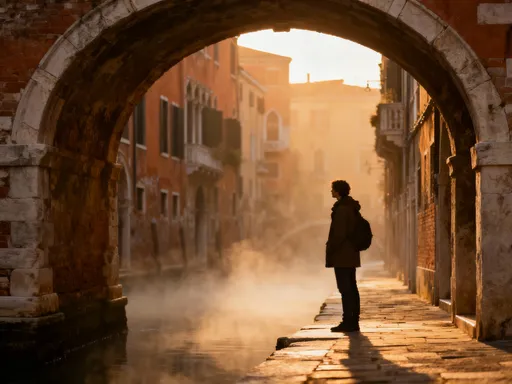
One of the most powerful tools for transforming your Venice experience is timing. The city’s rhythm changes dramatically with the hour, and those who adjust their schedules accordingly are rewarded with moments of unexpected serenity. While most tourists arrive mid-morning, the early hours—between 6:30 and 8:30 a.m.—offer a Venice few ever witness. St. Mark’s Square, usually packed by 10 a.m., is nearly empty at dawn. The marble glows in soft golden light, pigeons scatter in quiet patterns, and the only sound is the distant lapping of water against stone.
Photographing the Basilica at sunrise is an exercise in stillness. The golden mosaics catch the first rays, shimmering like liquid light. Without the usual crowd, you can walk slowly around the perimeter, noticing details often obscured by people: the carved lions, the weathered saints, the intricate patterns in the marble inlay. This is not just a better photo opportunity—it’s a deeper connection to the space.
Similarly, the Rialto Bridge transforms after sunset. Once the day-trippers have left and the cruise shuttles cease running, the area takes on a different character. The shops close, the noise fades, and the canal reflects the warm glow of streetlamps. Walking across the bridge at 8 p.m. or later, you might find yourself alone for a fleeting moment, with only the water and the stars above. The Bridge of Sighs, often viewed through a throng of cameras, can be seen in solitude from the nearby waterfront, its delicate arches outlined against the twilight sky.
Practical planning makes this possible. Start your day early, even if it means sacrificing a leisurely breakfast. Pack a coffee and pastry from a local bakery and enjoy it in the square as the city wakes. Plan your major visits around the light—museums and interiors can be saved for midday, when the sun is high and the crowds thickest. Use the afternoon for rest or quieter exploration, then return to key sites in the evening. The emotional payoff is profound: the sense of having Venice to yourself, even if only for a few stolen minutes.
The Power of the Pause: Slowing Down to Decode Architectural Stories
Venice’s architecture is a language, and like any language, it rewards those who take time to learn it. The façade of the Doge’s Palace, for example, is not just decorative—it is a coded message of power and legitimacy. The pointed arches and quatrefoil motifs echo Islamic influences, a nod to Venice’s role as a bridge between East and West. The statues of virtues and doges tell a story of divine right and civic duty. Yet most visitors glance and move on, missing the narrative embedded in the stone.
Rushing past such details flattens the experience. When we treat landmarks as backdrops for photos, we lose the opportunity to understand their significance. The mosaics inside St. Mark’s Basilica, which took centuries to complete, depict scenes from the Gospels and the life of Christ with astonishing detail. A hurried glance shows gold and color; a patient look reveals individual faces, gestures, and symbolic elements that convey theological meaning.
A more enriching approach is to pick one landmark per day to study, not just see. Choose the Doge’s Palace, for instance, and spend an hour focusing only on its exterior. Notice the differences between the lower and upper levels—the open loggias below suggest accessibility, while the enclosed chambers above imply secrecy and authority. Observe how light plays on the marble, how shadows define the carvings. Then, if possible, return later in the day to see how the same façade appears under different conditions.
This kind of focused observation links architecture to history. The design of these buildings reflects Venice’s unique political structure—a republic led by a doge, balanced by councils and committees. The Doge’s Palace was both a government seat and a residence, symbolizing the fusion of public and private power. The Basilica, originally the doge’s private chapel, became a symbol of the city’s spiritual and imperial ambitions. By slowing down, you begin to see not just beauty, but meaning. You understand that every column, every mosaic, every arch was placed with intention.
Angles That Matter: Finding Your Own View in a Photogenic City
Venice is one of the most photographed cities in the world, and with good reason. Its canals, bridges, and palazzos offer endless visual drama. But the most common angles—St. Mark’s Square from the Campanile, the Rialto Bridge from the opposite bank—are reproduced millions of times. To create images that feel personal, you must seek out less obvious perspectives.
This begins with exploration. Wander the side alleys—calli—that branch off from the main routes. One narrow lane near the Grand Canal, for example, opens unexpectedly onto a quiet stretch of water where a single gondola might glide past, framed by weathered brick and hanging laundry. Another, tucked behind the Basilica, offers a diagonal view of the campanile rising above red-tiled roofs, with no crowds in sight. These moments are not found on maps; they are discovered through curiosity and a willingness to stray from the path.
Reflections add another dimension. The canals, especially in the early morning or after rain, become mirrors. A shot of the Basilica’s façade doubled in the water creates symmetry and depth. The same applies to smaller details: a row of colored doors, a wrought-iron balcony, a lone lantern—all gain poetic resonance when mirrored in the lagoon’s surface. To capture these, patience is key. Wait for the water to still, for the light to align, for the moment to feel right.
Composing your shots without crowds requires timing and positioning. Arrive at popular viewpoints early or late. Use doorways, arches, or overhanging balconies to frame your subject, naturally excluding people from the scene. Focus on details rather than wide vistas—a single window, a patch of peeling paint, a weathered stone carving. These intimate images often tell a more authentic story than the panoramic postcard shots. They reflect not just what Venice looks like, but how it feels to be there.
Navigating Like a Venetian: Routes That Reveal, Not Just Connect
Most tourists follow the same routes: from the train station to Piazzale Roma, across the Rialto Bridge, down to St. Mark’s Square. These paths are efficient but predictable, leading through crowded thoroughfares and commercial zones. To experience Venice more deeply, consider how you move through it. Navigation becomes not just a means to an end, but a way of discovering the city’s soul.
Use less-known calli to travel between major sites. For example, instead of walking the busy Fondamenta degli Incurabili along the Grand Canal, try the parallel alley behind the Gallerie dell’Accademia. Quieter, narrower, and lined with residential buildings, it offers glimpses into daily Venetian life—a cat on a windowsill, laundry drying in the sun, an old man reading a newspaper. These small moments accumulate into a richer understanding of the city.
Strategic path planning enhances both efficiency and enjoyment. Link the Basilica, Campanile, and Procuratie in a circular route that allows you to see them from multiple angles. Start at the Basilica’s west front, walk behind it to the Piazzetta, cross to the Doge’s Palace, then loop back along the Procuratie Nuove. This creates a natural flow, avoiding backtracking and helping you build spatial memory. Over time, you begin to orient yourself not by landmarks alone, but by the relationships between them.
There is also value in getting slightly “lost” with intention. Venice’s maze-like layout can be disorienting, but that disorientation is part of its charm. Allow yourself to turn down an unfamiliar alley, to follow a path that seems to lead nowhere. Often, these detours open onto hidden campos, quiet canals, or unexpected views. The key is to do so with awareness—carry a simple map or use a phone app discreetly, so you can reorient when needed. This kind of wandering fosters emotional attachment. You’re no longer just passing through; you’re mapping the city in your mind and heart.
Engaging the Senses: Beyond the Visual at Venice’s Monuments
Venice is overwhelmingly visual, but limiting your experience to sight means missing half the story. The city engages all the senses, and tuning into them deepens your connection to its landmarks. At St. Mark’s Basilica, for example, the sound of the bells from the Campanile marks the passage of time, their echoes bouncing across the lagoon. The scent of damp stone and beeswax lingers in the air, a reminder of centuries of care and use. The coolness of the marble floor underfoot grounds you in the present moment.
Multi-sensory awareness turns sightseeing into immersion. Stand still for a minute in the Piazzetta and close your eyes. Listen to the water lapping against the mooring poles, the distant hum of a vaporetto, the rustle of pigeons taking flight. Feel the breeze off the lagoon, the sun on your face, the texture of the stone balustrade. These sensations anchor you in the place, making the experience more vivid and memorable.
Where permitted, touch can be especially powerful. The worn steps of the Doge’s Palace, smoothed by centuries of feet, tell a story of human contact. The cool iron of a canal-side ring, used to tie up boats, connects you to Venice’s maritime function. Even the roughness of aged brick or the smoothness of a carved column can evoke a sense of continuity across time. These tactile experiences create a physical memory that lasts longer than a photograph.
Practicing sensory engagement requires mindfulness. Set small intentions: “Today, I will notice three new sounds in the square.” Or, “I will pause once to feel the air and smell the surroundings.” These moments of attention break the autopilot mode of tourism and invite presence. They remind you that you are not just observing Venice—you are living in it, even if only for a short while.
Making It Last: Turning Visits into Meaningful Memories
The most fleeting aspect of travel is memory. Photos fade, souvenirs gather dust, and the excitement of being somewhere new can dissolve into routine. To make your Venice experience endure, you must actively transform it from a series of events into a collection of meaningful moments. This requires reflection and ritual.
Simple practices can make a difference. Carry a small notebook and spend five minutes after each visit sketching a detail—a window, a column capital, a pattern in the pavement. You don’t need to be an artist; the act of drawing forces you to look closely. Alternatively, write a short note: “What surprised me today,” or “One thing I noticed that no one else seemed to see.” These fragments become personal artifacts of your journey.
Revisiting a place twice can also deepen connection. Return to St. Mark’s Square in the evening after seeing it in the morning. Notice how the light, the sounds, the mood have changed. Sit on the same bench, order the same drink, and observe the shift. This creates a sense of continuity and allows you to compare and reflect. It turns a single visit into a dialogue with the place.
Reflection after each day cements the experience. Before sleeping, review your notes, look at your photos not just to admire them, but to recall how you felt. Ask yourself: What stayed with me? What surprised me? What do I want to remember a year from now? This practice shifts your mindset from collecting sights to collecting insights.
The ultimate goal is to move from seeing landmarks as endpoints to experiencing them as conversations across time. Each stone, each mosaic, each canal is a message from the past, and your presence is a response. When you approach Venice this way, you don’t just visit—you participate. And that participation leaves a mark not just on your memory, but on your way of seeing the world.
Venice’s landmarks aren’t just to be seen—they are to be lived in, moment by moment. With thoughtful timing, mindful observation, and intentional movement, even the most famous sites can feel intimate and fresh. This isn’t about ticking boxes. It’s about transforming travel into a deeper way of seeing—one that stays long after the photos fade.