You Won't Believe What I Found Exploring Daejeon's Hidden Architectural Gems
Daejeon isn’t the first city that comes to mind when you think of Korean architecture—but it should be. Tucked between mountains and modernity, this underrated hub blends tradition, innovation, and surprise at every corner. I went looking for landmarks and found soul instead: sleek research centers beside centuries-old temples, futuristic design woven into quiet alleys. If you're tired of the same tourist routes, Daejeon’s architectural heartbeat offers a fresh, authentic rhythm worth discovering.
Reimagining Daejeon: Beyond the Stereotypes
Daejeon is often dismissed as a transit city—a place to pass through on the high-speed rail between Seoul and Busan. Others know it only as Korea’s science capital, home to Daedeok Innopolis, a sprawling research complex that fuels the nation’s technological ambitions. Yet these labels barely scratch the surface of what Daejeon truly offers. To reduce it to a hub of laboratories or a railway junction is to overlook its quiet cultural depth, particularly in the way its built environment tells a story of balance, resilience, and understated beauty. The city’s architecture reveals a more nuanced identity—one that embraces progress without erasing history, and innovation without sacrificing humanity.
Unlike Seoul’s grand palaces or Busan’s seaside vibrancy, Daejeon’s charm lies in its subtlety. It doesn’t dazzle with spectacle but invites closer inspection. Its neighborhoods unfold gradually, rewarding those who wander with eyes open to detail. This is a city shaped by geography and vision, nestled in a valley surrounded by the Nokji and Gwanmosan mountains, where urban planning has long considered elevation, airflow, and natural harmony. The result is an architectural language that feels grounded, not imposed. Daejeon doesn’t shout; it speaks in quiet tones, through the curve of a tiled roof, the transparency of a glass façade, or the thoughtful placement of a footbridge over a stream.
What makes Daejeon particularly compelling is how its identity has been shaped not by tourism but by function and community. Schools, research institutes, parks, and residential zones have grown together organically, creating a layered urban fabric. This lack of overt commercialization means fewer cookie-cutter developments and more opportunities for authentic design solutions. When you walk through its districts, you’re not seeing a city built for postcards, but one built for living. And it is precisely this authenticity that makes its architectural discoveries so meaningful. For travelers seeking a deeper understanding of contemporary Korean life, Daejeon offers a rare glimpse into how cities can evolve thoughtfully, without losing their soul.
The Fusion of Old and New: A City in Dialogue with Time
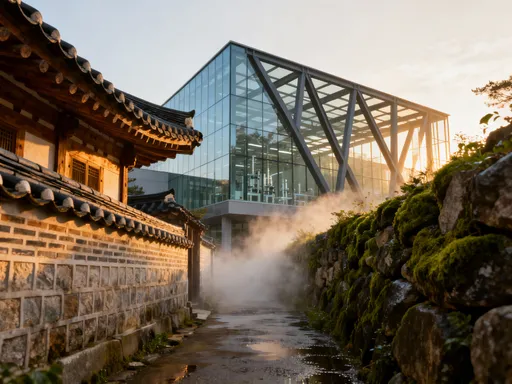
One of the most striking aspects of Daejeon’s architecture is how seamlessly it integrates the old with the new. Rather than treating historical preservation as a museum exhibit, the city embeds tradition into the rhythm of daily life. This is evident in places like Yongunsa Temple, a serene Buddhist complex tucked into the slopes of Gwanmosan Mountain. While the temple itself dates back over a thousand years, its presence is not isolated. Modern walking trails lead up to its gates, and nearby residential areas incorporate subtle design nods—curved eaves, wooden latticework, and stone pathways—that echo its aesthetic without mimicking it.
In other parts of the city, traditional hanok elements appear in unexpected ways. A community center in the Jung-gu district, for instance, features a gently sloping roofline reminiscent of Joseon-era homes, but constructed with modern materials and open-plan interiors. These adaptations are not about nostalgia; they reflect a living relationship with heritage. The architecture acknowledges the past not through replication, but through reinterpretation. This dialogue between eras is further enhanced by the city’s use of space. Parks like Daejeon Expo Park, originally developed for the 1993 Daejeon Expo, now serve as green connectors where ancient-looking pavilions stand beside sleek, contemporary structures, creating a visual conversation across centuries.
The harmony between old and new extends to urban planning principles. Daejeon has long embraced the Korean concept of *pungsu-jiri*—the traditional geomantic practice of aligning buildings with natural energy flows. While not always explicitly labeled as such, this philosophy influences the orientation of buildings, the layout of streets, and the preservation of sightlines to mountain peaks. It’s a subtle but powerful force that ensures development respects the land rather than dominates it. As a result, even in newer districts, there’s a sense of continuity—a feeling that the city grows not in spite of its history, but because of it.
Science Meets Aesthetics: Daejeon’s Research Districts and Futuristic Design
No discussion of Daejeon’s architecture would be complete without addressing its role as a national leader in science and technology. At the heart of this identity is Daedeok Innopolis, a research and development cluster that hosts hundreds of government institutes, universities, and private labs. While its primary function is scientific, the district’s architecture is far from utilitarian. On the contrary, it exemplifies how functional design can also be visually compelling. Glass curtain walls reflect the sky, angular forms suggest forward motion, and open atriums invite natural light deep into workspaces—each element contributing to an environment where innovation can thrive.
What sets these buildings apart is their intentionality. The Korea Advanced Institute of Science and Technology (KAIST), for example, features a campus where modernist simplicity meets ecological sensitivity. Low-rise structures are arranged to minimize wind resistance and maximize solar gain, while shaded walkways and water features help regulate microclimates. Even the interiors are designed with cognitive well-being in mind—ample daylight, natural materials, and flexible workspaces support both concentration and collaboration. These are not just laboratories; they are thoughtfully composed environments that recognize the link between physical space and intellectual output.
Yet for all its high-tech presence, Daedeok Innopolis avoids the cold sterility that sometimes plagues science districts. Landscaped courtyards, public art installations, and pedestrian-friendly pathways soften the urban fabric. A visitor might stumble upon a stainless-steel sculpture inspired by molecular structures or a quiet plaza where researchers gather during breaks. These human-scale interventions ensure that the district remains accessible and inviting, not just to scientists but to residents and curious travelers alike. In Daejeon, science and aesthetics are not opposing forces—they are partners in shaping a city that values both discovery and dignity.
Green Urbanism: How Architecture Embraces Nature
Daejeon’s relationship with nature is not merely scenic—it is structural. The city’s topography, defined by rolling hills and meandering streams, has influenced its architectural development in profound ways. Rather than flattening the land for uniform construction, planners have worked with the contours, allowing buildings to step down slopes, follow riverbanks, and preserve tree-lined corridors. This approach results in a built environment that feels integrated rather than intrusive. One of the best examples is the Daejeon Sky Road, a pedestrian bridge that winds through the treetops near Yuseong District. Designed to minimize ground disruption, it offers panoramic views while maintaining the integrity of the forest below.
Sustainability is not an afterthought in Daejeon—it is embedded in the city’s design DNA. Many public buildings incorporate green roofs, rainwater harvesting systems, and passive solar heating. The Daejeon Green Building Center, located in the Seo-gu district, serves as both a demonstration site and an educational hub, showcasing energy-efficient materials, natural ventilation techniques, and renewable energy integration. Even smaller-scale projects, like neighborhood libraries and community centers, frequently include rooftop gardens or vertical greenery, blurring the boundary between built and natural environments.
The city’s commitment to green urbanism extends to its transportation planning. Wide sidewalks, protected bike lanes, and shaded bus stops encourage low-carbon mobility. Along the Gapcheon Stream, a restored urban waterway, a continuous greenway connects parks, schools, and residential areas, making it easy for families to walk or cycle from one end of the district to another. Along the path, benches, viewing platforms, and native plantings enhance the experience, turning what was once a neglected drainage channel into a vibrant ecological corridor. In Daejeon, architecture doesn’t just coexist with nature—it actively nurtures it.
Hidden Corners: Off-the-Beaten-Path Structures with Soul
Beyond the well-known institutions and scenic parks, Daejeon reveals its most intimate architectural moments in its quieter corners. These are not the sites featured in glossy brochures, but the places that reward slow exploration—the alley behind a market where a former tram depot has been converted into a ceramic studio, or the narrow lane in Dong-gu where hand-painted murals cover the walls of repurposed warehouses. Each of these spaces tells a story of transformation, of how old structures find new life through creativity and community care.
One such discovery is the O-World Art Tunnel, a former underground passage beneath a major road that has been reimagined as a rotating gallery for local artists. Lit with soft, color-shifting LEDs and lined with textured panels, the tunnel creates an immersive experience that feels both futuristic and intimate. Nearby, the remnants of the old Daejeon Station—part of the original Gyeongbu Line—have been preserved as a cultural plaza. Though the main terminal has been modernized, the original brick façade remains, standing as a quiet monument to the city’s transit history. Benches and informational plaques invite passersby to pause and reflect, turning what could have been demolition into dialogue.
These hidden gems are not defined by scale or fame, but by their ability to evoke emotion. A small tea house in the Yuseong hot springs district, built with reclaimed wood and heated with geothermal energy, offers a moment of stillness amid the urban flow. Its sliding paper doors open to a rock garden where water trickles over moss-covered stones—a detail that speaks to the care invested in every element. In such places, architecture becomes more than shelter; it becomes an invitation to slow down, to notice, to connect. For the thoughtful traveler, these are the moments that linger longest.
Public Spaces as Architectural Experience
In Daejeon, public spaces are not afterthoughts—they are central to the city’s architectural philosophy. Plazas, bridges, and transit hubs are designed not just for efficiency, but for experience. Take the redesigned Daejeon Station, which opened in the early 2010s as part of a national modernization effort. The new structure features a sweeping glass canopy that floods the concourse with natural light, while its open layout improves wayfinding and reduces congestion. But beyond functionality, the design creates a sense of arrival. The interplay of light and shadow, the use of warm-toned stone flooring, and the integration of digital information displays in elegant frames all contribute to an atmosphere of calm efficiency.
Equally impressive are the city’s riverside promenades, particularly along the Gapcheon and Yudeungcheon streams. These are not mere pathways, but layered experiences. Wide, smooth surfaces accommodate strollers and cyclists, while stepped seating areas allow people to sit and watch the water. In spring, cherry blossoms line the banks; in autumn, ginkgo trees turn golden. Public art installations—stone carvings, kinetic sculptures, and illuminated fountains—add moments of surprise. The design ensures that these spaces are used year-round, not just as transit routes but as destinations in themselves.
Even the city’s bridges serve dual purposes. The Gwanak Sky Bridge, connecting two hills in Gwanak Park, is engineered for stability and safety, but its transparent railings and elevated walkway offer breathtaking views of the city below. It’s a structure that invites lingering, not just crossing. Similarly, the Hanbat Grand Bridge includes dedicated lanes for pedestrians and cyclists, with rest areas and lighting that enhance safety and comfort. In Daejeon, infrastructure is not hidden or purely utilitarian—it is elevated to the level of civic art, reflecting a belief that everyday experiences deserve beauty and care.
Why Daejeon’s Architecture Matters—And Where It’s Headed
Daejeon’s architectural landscape offers more than aesthetic pleasure—it provides a model for how cities can grow with intention. In an era of rapid urbanization, where many metropolitan areas prioritize density and speed over harmony and well-being, Daejeon stands out for its measured approach. It proves that progress does not require the erasure of history, nor does innovation demand the sacrifice of nature. Instead, the city demonstrates that balance is not only possible but enriching. Its buildings, parks, and public spaces reflect a deep respect for context—geographic, cultural, and social.
What makes Daejeon particularly relevant today is its quiet leadership. It does not seek global fame or architectural superlatives. There are no record-breaking skyscrapers or celebrity-designed landmarks. Yet in its understated way, the city is shaping the future of Korean urbanism. Its emphasis on sustainability, walkability, and community-oriented design aligns with global best practices while remaining rooted in local values. As climate challenges intensify and cities worldwide seek resilient models, Daejeon’s integration of green infrastructure, energy efficiency, and human-centered planning offers valuable lessons.
Looking ahead, the city continues to evolve. New developments in the northern districts aim to expand housing while preserving green belts. Smart city technologies are being tested in pilot neighborhoods, focusing on energy management and public service efficiency. Yet even as it embraces change, Daejeon maintains its core principle: that architecture should serve people, not just systems. For travelers, this means an ever-unfolding journey of discovery—one where every corner holds the potential for surprise, and every structure tells a story of care, continuity, and quiet courage. In a world that often values noise over nuance, Daejeon whispers a different truth: that the most meaningful places are not the loudest, but the ones that listen.